
Public preview · Pending editorial review
The patch is out. Is it inside your appliance?
An upstream fix is only the first step when a vulnerable component is embedded in a vendor product. A new infrastructure security report shows why teams need to track the journey from component advisory to the version actually running on each device.
In this story

The fix has a journey
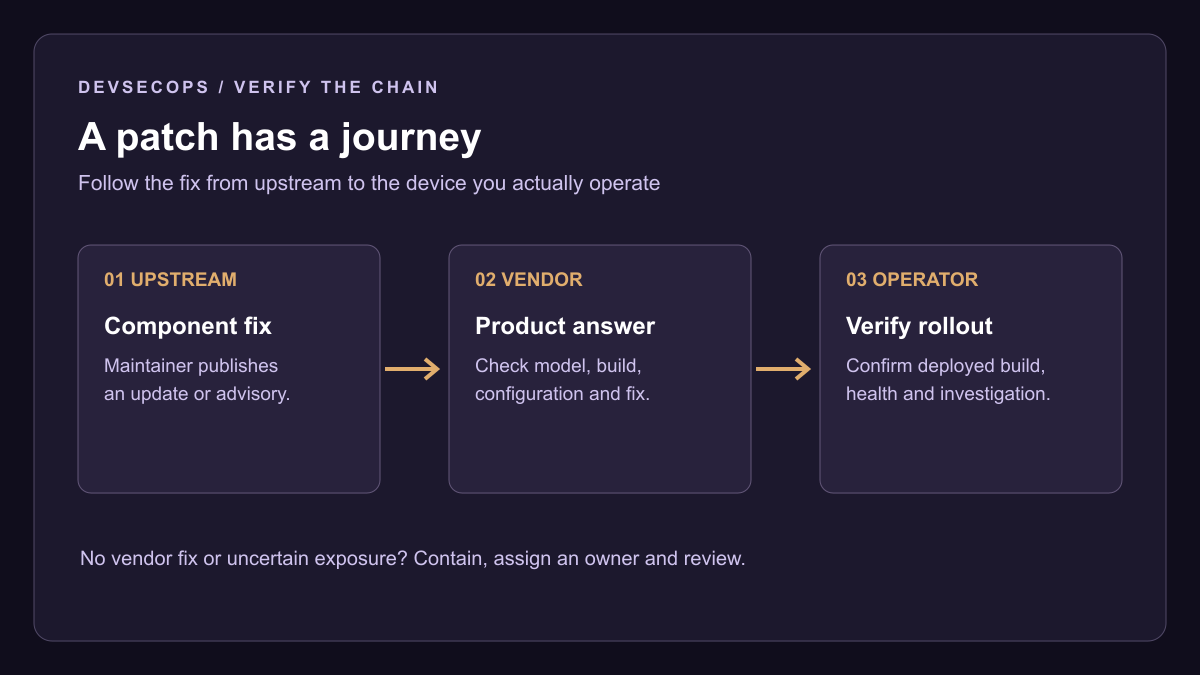
A component patch only helps after the right product update reaches the right device.
- Upstream fix
A component maintainer releases a security update.
- Product-specific answer
The vendor evaluates affected versions and configurations.
- Fix available
Identify the correct release for the product and plan deployment.
- Not yet available or unknown
Track the vendor notice, restrict exposure and assign an owner.
- Fix available
- Verify in your environment
Confirm the installed build, service health and any needed compromise investigation.
What the November report found
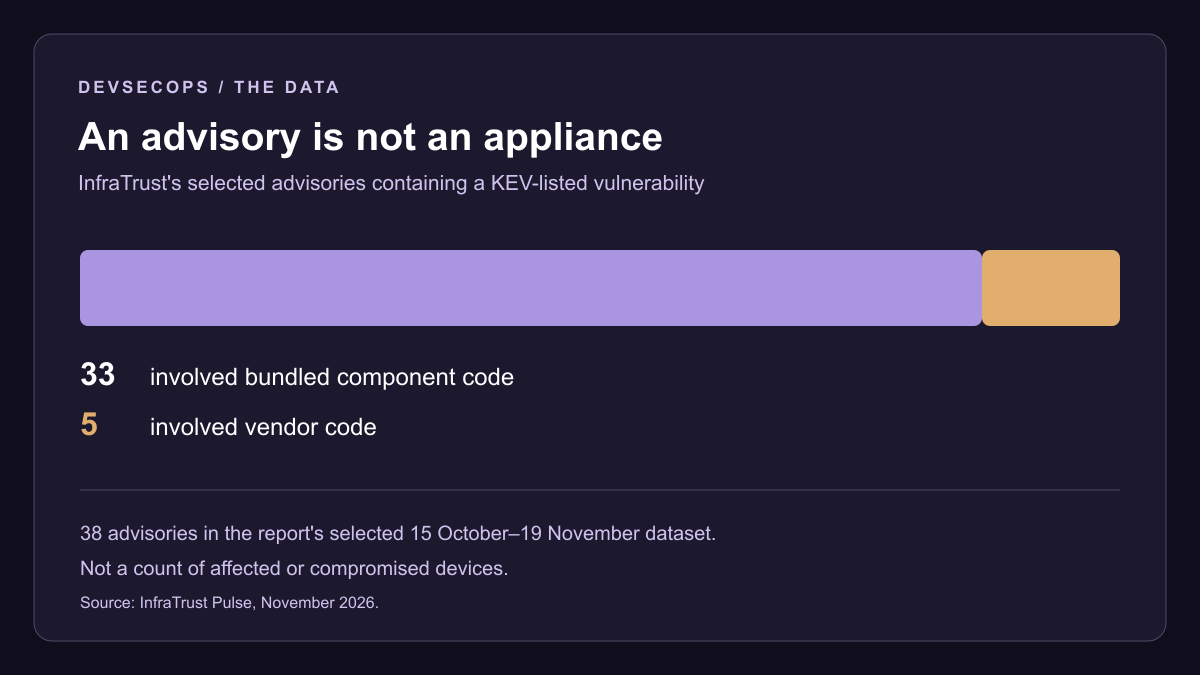
On 25 November, InfraTrust published its monthly analysis of 373 infrastructure security advisories from 23 vendors, covering 15 October through 19 November. It identified 38 advisories containing a vulnerability listed in CISA's Known Exploited Vulnerabilities catalog; the report says 33 of those 38 involved a vulnerable component bundled into a vendor product. These are counts of advisories in the report's selected dataset, not counts of affected devices or an estimate for the entire industry. [1] [2]
The operational gap is easy to miss: the component maintainer publishes a fix, each product vendor determines exposure and ships its own update, and your team still has to deploy and verify that update. An upstream announcement alone is not proof that your appliance is fixed.
One component, different product answers
InfraTrust uses the PHP vulnerabilities CVE-2026-109618 and CVE-2026-109619 as an example of a shared component reaching network products. Palo Alto Networks' advisory lists product-specific affected and unaffected versions; Check Point reports exploitation against unpatched internet-facing gateways and recommends its November Jumbo Hotfix. Do not copy a fix version across vendors or product branches: consult the advisory for the exact model and release. [1] [3] [4]
The report's vendor table is a snapshot as of 20 November. Availability and status may change; verify the current vendor notice rather than treating an older table as a live inventory. A product can bundle a component without being affected in every configuration, so component presence is a lead to investigate, not proof of exploitability.
An SBOM helps; a decision needs more
A software bill of materials (SBOM) lists software components; CISA describes Vulnerability Exploitability eXchange (VEX) as a way to communicate whether products are affected by known vulnerabilities. Both can help you map a CVE to a product, but an incomplete or outdated document is not a clearance certificate. Record its release and generation date, then match it to the deployed version. [5]
Add the details the inventory does not answer by itself: which device is internet reachable, whether the affected feature is enabled, which advisory applies, when a fix is available, and whether the update actually reached the device. Unknown is a status with an owner, not a synonym for safe.
Five checks for the next component alert
Start with one critical service and its edge appliances. Use normal change controls and vendor-supported procedures; do not experiment with exploit code against production.
- Build an inventory linking appliance model, serial or asset ID, deployed software build, owner, enabled features and management interfaces. Include standby and disaster-recovery devices.Evidence: A dated device list reconciled against actual network and management inventory.
- Map the component and CVE to exact product releases using current vendor advisories and, where available, a release-matched SBOM or VEX. Record affected, not affected and unknown separately; follow up on missing information.Evidence: A per-product decision with advisory link, document version, check date and owner for unresolved entries.
- Prioritize exposed or business-critical affected systems. If a fix is unavailable, apply vendor-supported mitigations such as restricting management access and segmenting reachable interfaces; verify that the restriction works and has an expiry or review date.Evidence: An approved exception with tested access controls, affected assets, owner and next review time.
- Test and roll out the correct product-specific update under an approved maintenance plan. Check the installed build on each active and standby device, not just the change ticket or download record.Evidence: Before-and-after version records, health checks and a documented rollout or exception for every affected device.
- Where exploitation was possible before remediation, follow the vendor's incident-response guidance, preserve logs and escalate suspected compromise. A patch can stop a vulnerable path without removing persistence or proving the device was never compromised.Evidence: A time-bounded investigation record, available logs, responder decision and recovery actions where needed.
What the numbers do not say
The 33-of-38 finding describes advisories selected by the report's authors, not the share of deployed appliances that were compromised, exploitable or exposed to the internet. BleepingComputer reports on the same research; its article is not an independent replication of the dataset. [1] [2]
Research window: 20–26 November 2026 UTC. This public preview uses the 25 November report as the weekly trigger; earlier vendor notices provide technical context. No claim is made about your environment. The reassuring green checkbox belongs at the end of the chain, not at the start.
Sources and limits
- InfraTrust Pulse: November 2026 25 November 2026. Primary report and selected advisory dataset; vendor status table is dated 20 November.
- BleepingComputer: InfraTrust warns of exploited supply chain flaws in network appliances 25 November 2026. Reporting on the InfraTrust report, not independent replication.
- Palo Alto Networks: CVE-2026-109618 product advisory Vendor-specific affected and fixed releases; check the current notice for your product.
- Check Point: Active exploitation of PHP2Shell and local privilege escalation Vendor report on observed attacks, affected products and recommended actions.
- CISA: Software Bill of Materials Background on SBOM and VEX, not evidence that a specific device is affected.